Longhao Qian
Postdoctoral Researcher, Flight Systems and Control (FSC) Lab, University of Toronto Institute for Aerospace Studies (UTIAS)

University of Toronto Institute for Aerospace Studies
4925 Dufferin St, North York
ON M3H 5T6, Canada
I’m a Postdoctoral Researcher at the University of Toronto Institute for Aerospace Studies (UTIAS), working with Prof. Hugh H.T. Liu in the Flight Systems and Control (FSC) Lab. I build intelligent aerial robots: drones and drone-mounted manipulators that can perceive, reason, and physically interact with the world around them.
My work combines reinforcement learning, physics-informed neural networks with stability guarantees, and vision-language models, and I care about taking these methods out of simulation and onto real flight hardware. Recent projects include VLM-driven aerial grasping, contraction-based neural control, and cooperative drone navigation with UWB and LiDAR.
Before returning to UTIAS, I spent two years at Huawei as a chip software engineer, developing drivers and positioning algorithms for low-power ranging chips. I received my Ph.D. from UTIAS, where I worked on cooperative payload transportation with multiple drones, and I teach graduate courses on flight mechanics and UAV autonomy.
More details: publications · research · industrial experience · teaching · CV
featured projects
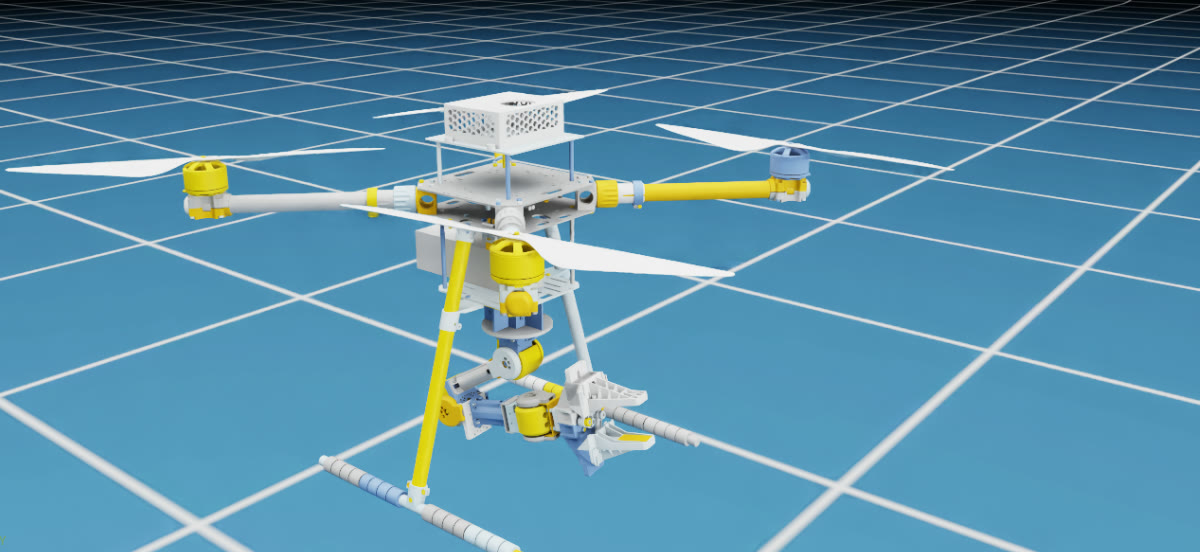
Aerial Embodied Intelligence and Vision-Language Models (VLMs) on a Drone-Manipulator Platform
L1 adaptive control for an aerial manipulator (3–4 cm average manipulation error), PPO sim-to-real correction, 400 Hz control from a Jetson Orin, and Qwen2.5-VL-driven autonomous grasping.
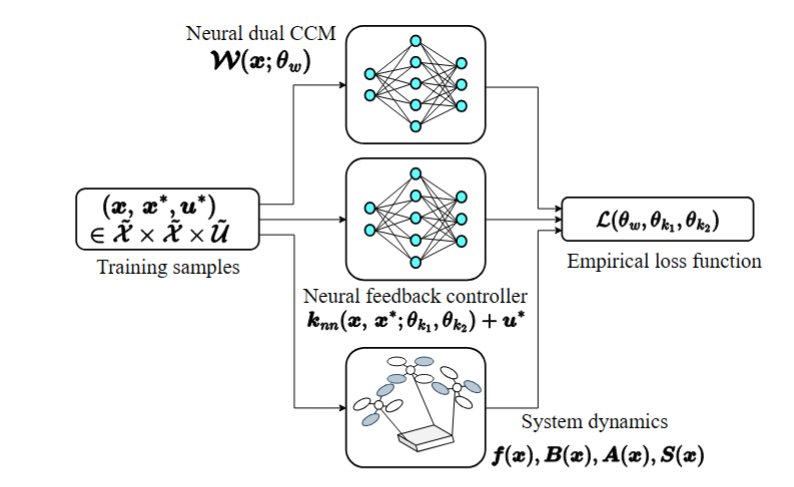
Trustworthy AI Control Framework Based on Physics-Informed Neural Networks (PINNs)
PINN-trained controllers with stability guarantees, generated without any training data; contraction metrics on Riemannian manifolds (RCCM) for singularity-free robust control. Accepted at CDC 2026 and AIAA SciTech 2027.
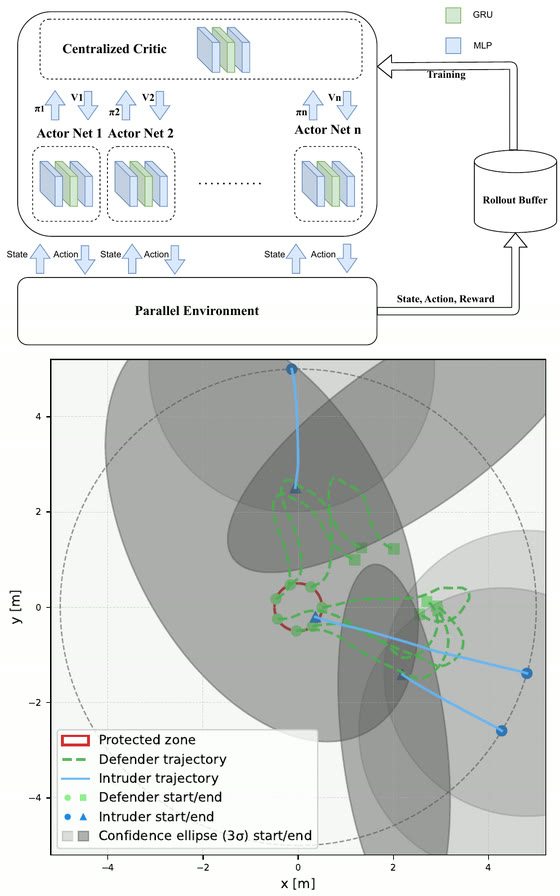
Reinforcement Learning for Drone Territory Security and Counter-UAV Interception
Autonomous swarm defense and interception from radio angle-of-arrival measurements alone, using MADDPG and an RNN-based HA-RMAPPO framework. Published in Science China Technological Sciences.
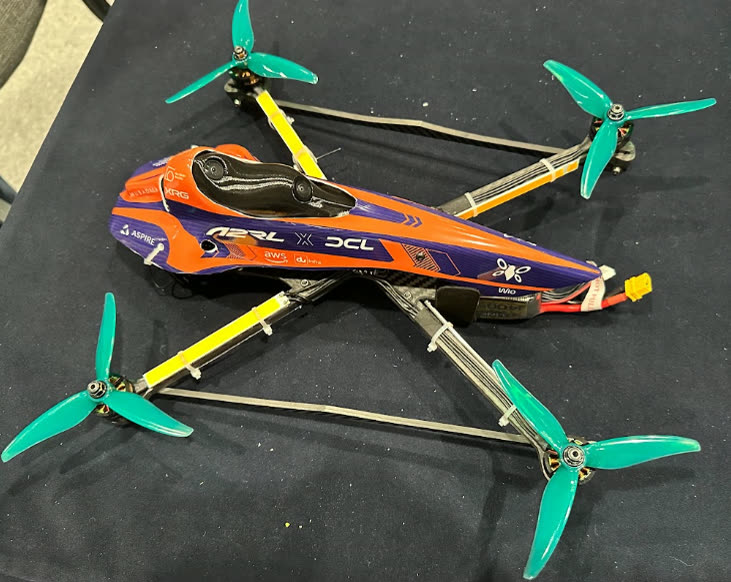
2025 A2RL Abu Dhabi Autonomous Drone Racing
Lead of the control and visual-navigation subsystems for the University of Toronto team: monocular-camera-only racing, 7th of 22 teams and a US$10,000 prize; ~15 cm tracking accuracy at 8–12 m/s.
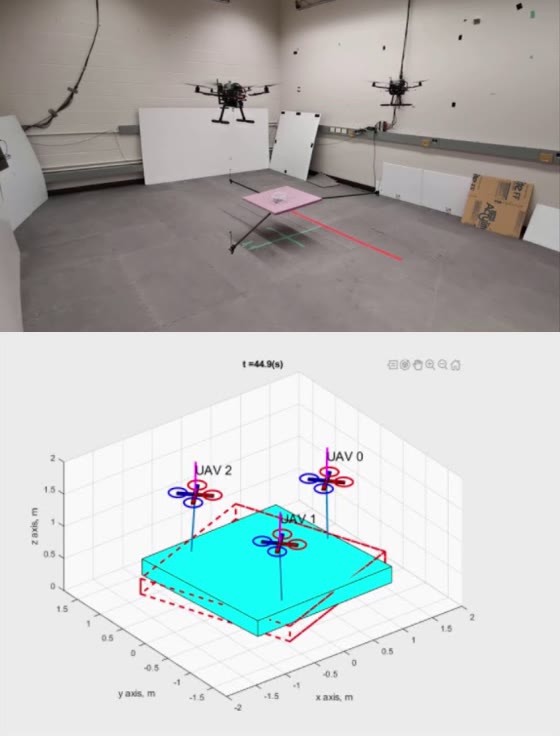
Ph.D. Research: Cooperative Tethered-Payload Transportation with Multiple Drones
Lyapunov-based nonlinear control for multi-drone tethered-payload transport (JGCD, IEEE TIE, IEEE/ASME TMECH; 300+ citations), implemented from scratch in C++/ROS on a Jetson Nano with a Pixhawk.